Beyond the Licence Fee: What Does an Open Integration Platform Really Cost?
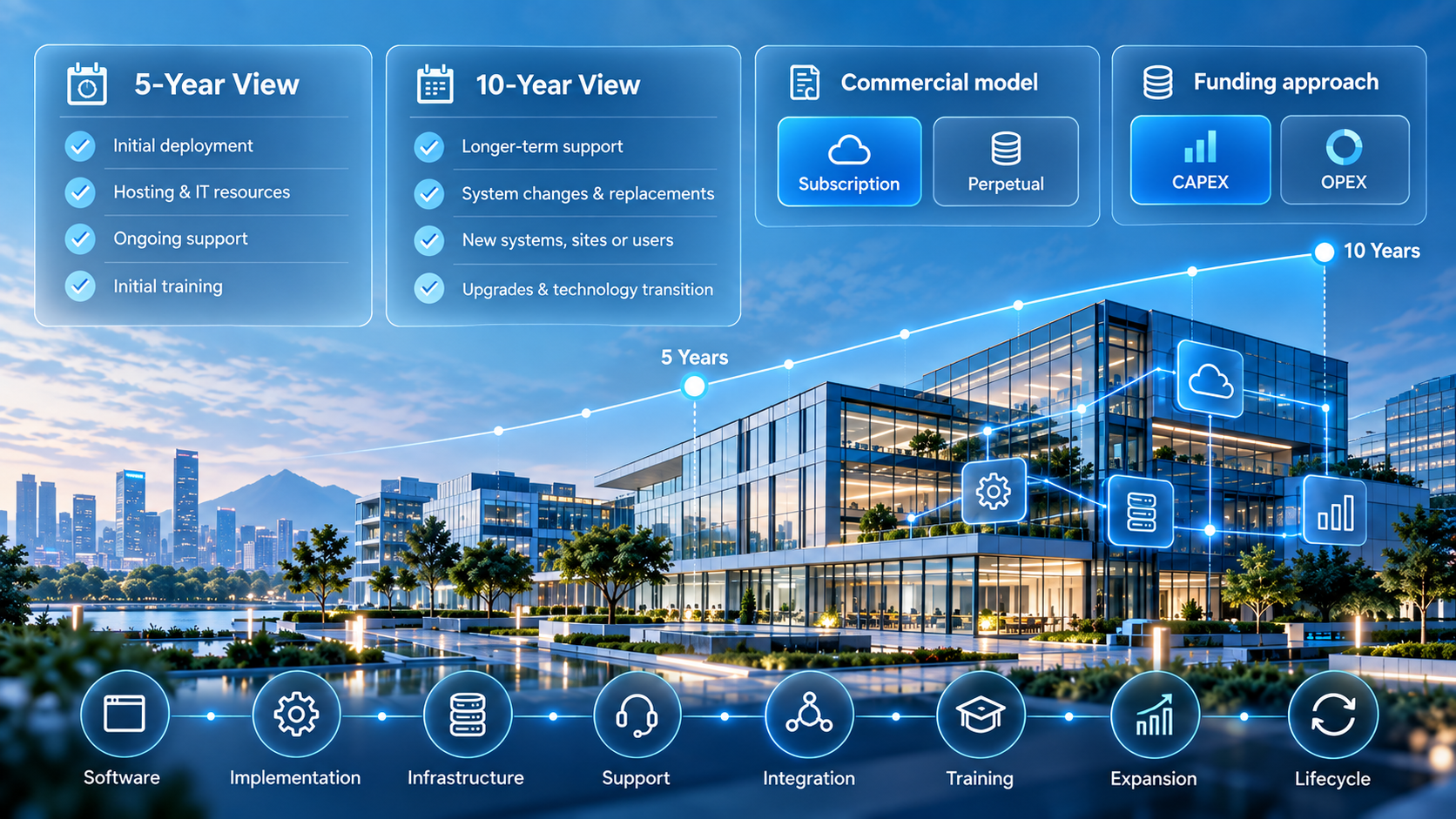
When evaluating an Open Integration Platform, the lowest upfront price does not necessarily represent the lowest cost.
For building owners and operators, this distinction matters. An integration platform may remain part of the operational environment for ten years or more, while the systems connected to it; CCTV, access control, fire, BMS, intercom, lifts and other technologies, continue to change around it.
A commercial decision made primarily on the basis of the initial licence fee can therefore overlook some of the costs that matter most over the life of the platform.
What will it cost to support? How will licensing costs develop over time? What happens when systems are replaced, new sites are added or additional integrations are required? How much engineering will be needed to keep the environment current? And what is the operational cost of continuing to manage multiple disconnected systems?
These questions move the conversation away from purchase price and towards Total Cost of Ownership (TCO).
For organisations investing in long-life buildings and infrastructure, TCO provides a much more useful basis for evaluating an integration platform because it considers not only what the technology costs today, but what it may cost to own, operate and evolve over its useful life.
The licence price is only the starting point
The initial software cost is the most visible part of a technology investment, but it is only one component of TCO.
For an integration platform, costs can typically fall into four broad areas.
1. Acquisition
This includes the initial software licence or subscription, implementation, configuration and project delivery.
2. Infrastructure
Servers, virtual machines, operating systems, networking and the IT resources required to operate the platform all form part of the overall cost.
3. Ongoing operation
Support, maintenance, system administration, training, software updates and engineering changes continue throughout the life of the platform.
4. Future change
Buildings and facilities do not remain static.
Systems are replaced, new technologies are introduced, sites expand and operational processes change.
The cost of adapting the integration platform to those changes can become a significant part of its long-term TCO.
This is why simply comparing licence prices can sometimes produce a misleading result.
Subscription or perpetual licensing?
Another important consideration is how the software is licensed.
Most organisations will be familiar with subscription-based software, where a recurring fee is paid for continued access to the platform.
The alternative is a perpetual licence, where the software is purchased upfront and the customer retains the right to use that licensed version of the platform.
Neither model is inherently better.
They simply suit different commercial and operational circumstances.
Sky-Walker can be offered under both subscription and perpetual licensing models, allowing the commercial arrangement to better align with the customer’s project and financial strategy.
Subscription licensing: spreading the investment
A subscription model can be attractive where an organisation wants to reduce the initial project expenditure.
Instead of making a larger software investment at the beginning of the project, the cost is distributed across the operating period.
This can provide several advantages:
Lower initial expenditure
Predictable recurring costs
Reduced upfront capital requirement
Greater flexibility for shorter-term deployments
Potential alignment with an OPEX-focused procurement strategy
Depending on the commercial model, software support, maintenance or updates may also be incorporated into the subscription.
For many organisations, this simplicity can be valuable.
However, the recurring nature of the cost is also something that should be considered over the full expected life of the platform.
A subscription that appears very attractive over three years can look quite different when modelled across ten or fifteen years.
Perpetual licensing: investing for the longer term
A perpetual licence takes a different approach.
The organisation makes a larger initial investment in the software and retains the right to continue using the licensed platform.
This may suit organisations that:
Have available project capital
Expect to operate the platform for many years
Prefer greater long-term certainty around licence expenditure
Want to separate software ownership from ongoing support and maintenance
Have a CAPEX-focused procurement strategy
A perpetual licence does not mean that the system becomes free to operate.
There will still be costs associated with support, infrastructure, upgrades, system changes and future engineering.
The difference is that the base software licence itself is not being purchased again every year simply to continue using the platform.
Over a long operational lifecycle, that distinction can become important.
CAPEX or OPEX? It depends on the organisation
The choice between subscription and perpetual licensing is often influenced by how an organisation prefers to fund technology.
A perpetual licence may support a CAPEX-oriented procurement model, particularly where the software forms part of a larger infrastructure project.
A subscription arrangement may support an OPEX-oriented approach by distributing expenditure across the operating life of the platform.
But it is important not to treat those classifications as automatic.
The accounting treatment of software can depend on the contract structure, applicable accounting standards and the organisation’s own accounting policies.
From a TCO perspective, the more useful question is:
Which commercial model best aligns with the organisation’s financial strategy and expected period of ownership?
Think about the asset lifecycle
This is particularly important in the built environment.
A commercial building, hospital, industrial facility or transport asset may remain operational for decades.
The technology inside it will change many times during that period.
A CCTV system may be replaced.
An access control platform may be upgraded.
Fire systems may be modernised.
A BMS may be changed.
New sensors, analytics platforms or operational technologies may be introduced.
An integration platform can provide a consistent operational layer across those changing technologies.
That makes the expected lifecycle of the platform an important part of the commercial decision.
A useful principle is:
Match the licensing horizon to the asset horizon.
If a platform is expected to remain operational for ten or fifteen years, evaluate its commercial model over ten or fifteen years and not just the first project budget.
Look at more than one TCO timeframe
One of the simplest ways to improve a commercial comparison is to model more than one ownership period.
For example:
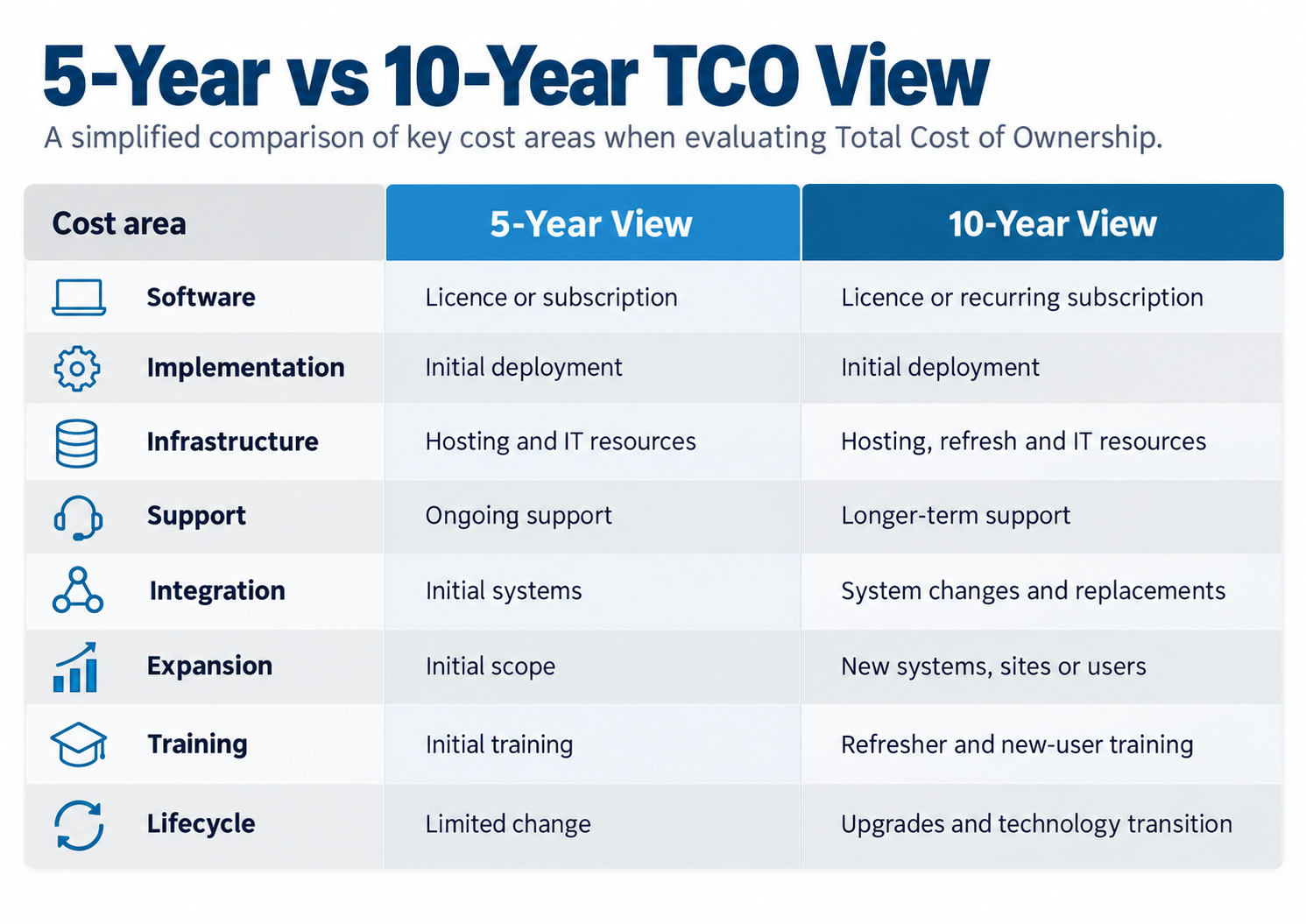
This type of comparison can reveal costs that are easy to overlook during the initial procurement process.
It can also show how the relative importance of the original software price changes over time.
The integration architecture matters too
Licensing is only one part of TCO.
The architecture of the platform can have just as much influence on lifecycle cost.
A modern facility is rarely built around technology from a single manufacturer.
It may contain CCTV, access control, intrusion detection, fire, intercom, building management, lifts, duress, environmental monitoring and other specialist systems from multiple vendors.
Over time, some of those systems will inevitably be replaced.
If replacing one subsystem requires the entire integration environment to be redesigned, the cost of change can become substantial.
An open, vendor-agnostic integration strategy can help reduce that dependency.
Instead of replacing the operational layer each time an underlying technology changes, new systems can be integrated into the existing environment.
That can provide continuity for operators while allowing the technology beneath the platform to evolve.
Do not overlook the cost of complexity
Some TCO costs never appear on a software invoice.
Consider a control room operator dealing with an incident.
They may need to move between several applications:
CCTV.
Access control.
Intercom.
Fire.
Building management.
Incident reporting.
Each application may have its own interface, alarm handling process and training requirements.
The cost of operating those systems independently can be difficult to quantify, but it is still real.
It can appear through:
Additional operator workload
Longer event investigation times
Duplicate administration
Multiple training requirements
Manual reporting
Inconsistent procedures
Increased engineering dependency
Greater operational complexity
An Open Integration Platform can bring information from those systems into a common operating environment, helping operators understand events in context and follow more consistent workflows.
That operational efficiency should also form part of a meaningful TCO discussion.
Five questions worth asking
When comparing integration platforms, organisations should consider more than the initial quotation.
Ask:
What will this platform cost over five, ten or fifteen years?
Does the licensing model suit how we want to fund the project?
What happens to our costs as we add systems, sites or users?
How easily can the platform adapt when our underlying technologies change?
What operational costs could be reduced by simplifying how our teams interact with multiple systems?
Those questions provide a much more complete picture than simply asking which platform has the lowest Year One price.
Commercial flexibility with Sky-Walker
Sky-Walker is designed to support integration across security, safety, building and operational technologies without locking the customer into a single manufacturer or system ecosystem.
Its commercial model follows a similar philosophy.
Sky-Walker can be offered through either subscription or perpetual licensing, depending on the requirements of the organisation.
For some customers, a subscription model may provide the right combination of flexibility and predictable operating expenditure.
For others, particularly those planning to retain the platform over a long asset lifecycle, perpetual licensing may provide a more appropriate commercial structure.
The important point is that customers can evaluate the model that suits their circumstances rather than being forced into a single licensing approach.
Look beyond Year One
The initial cost of an Open Integration Platform matters.
But the lowest purchase price does not necessarily represent the lowest cost of ownership.
A meaningful evaluation should consider the complete lifecycle:
Licence. Implementation. Infrastructure. Support. Integration. Expansion. Training. Change. Operations.
It should also consider how long the platform is expected to remain in service.
For organisations investing in long-life buildings and infrastructure, the most revealing commercial comparison may not be the difference between two software prices today.
It may be the difference between two ownership strategies over the next ten years.
Summary
Total Cost of Ownership is ultimately about making a better long-term investment decision and not simply choosing the lowest upfront price. With Sky-Walker available through both subscription and perpetual licensing models, Integratek can help organisations assess the commercial model that best fits their budget, operational requirements and expected asset lifecycle.
If you are considering an Open Integration Platform, preparing a business case or reviewing the long-term cost of your current integration environment, contact Integratek to discuss your requirements and explore how Sky-Walker could deliver greater flexibility, operational efficiency and long-term value.