One Building, Multiple Systems… and No Single View
Spend a bit of time with almost any building operator and you’ll start to hear the same frustrations.
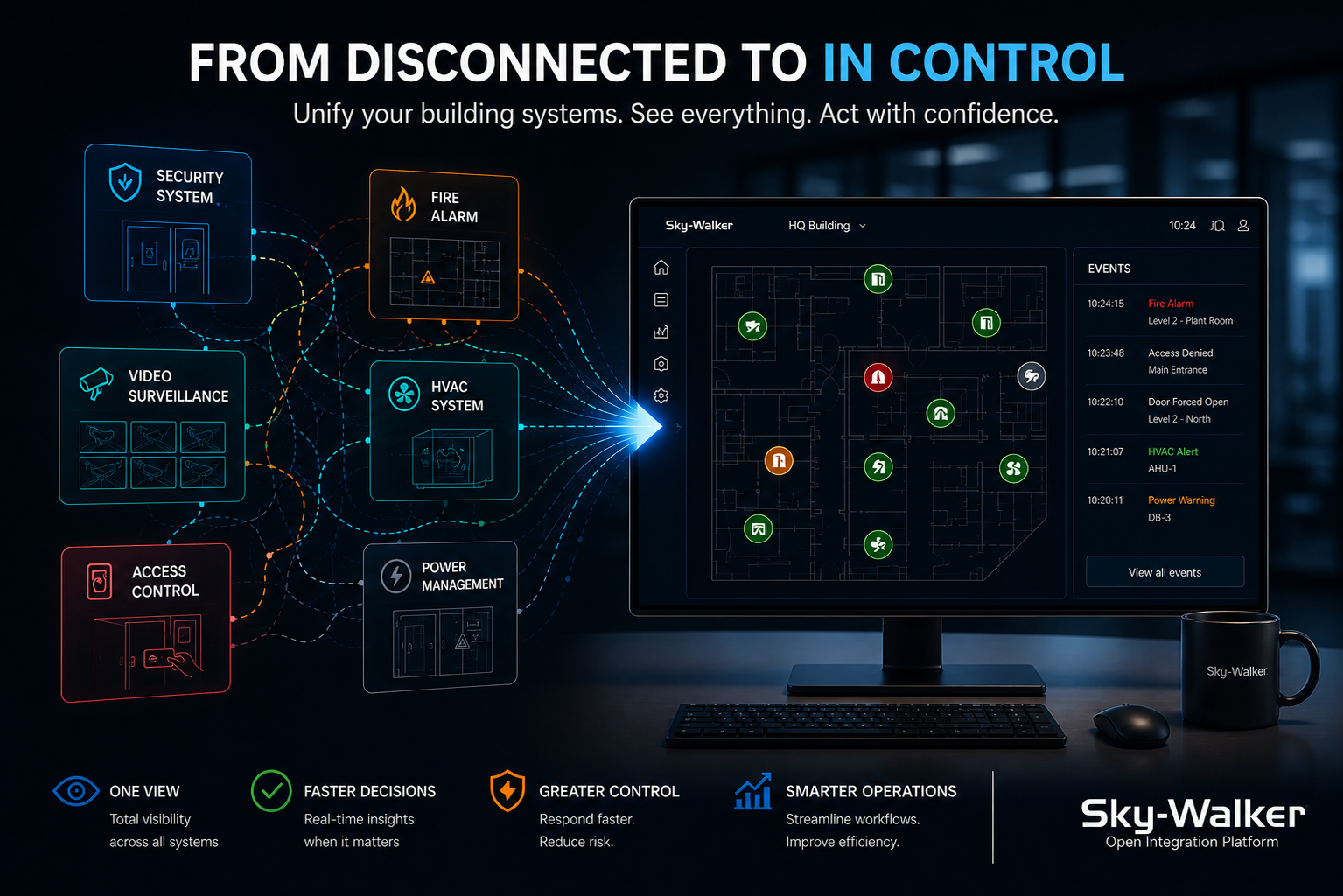
Not about the systems themselves—most of them do exactly what they’re supposed to do. The issue is how disconnected everything feels when you actually try to run the building.
Security sits on one platform.
Fire is somewhere else entirely.
HVAC and energy live in the BMS.
Access control has its own interface again.
Before long, you’re juggling screens, logging into different systems, or in some cases physically heading out to a panel in a plant room just to check what’s going on.
It works… but it’s not exactly efficient. And when something goes wrong, that’s when the cracks really show.
When It Matters Most, Everything Feels Disconnected
Think about a fairly typical scenario.
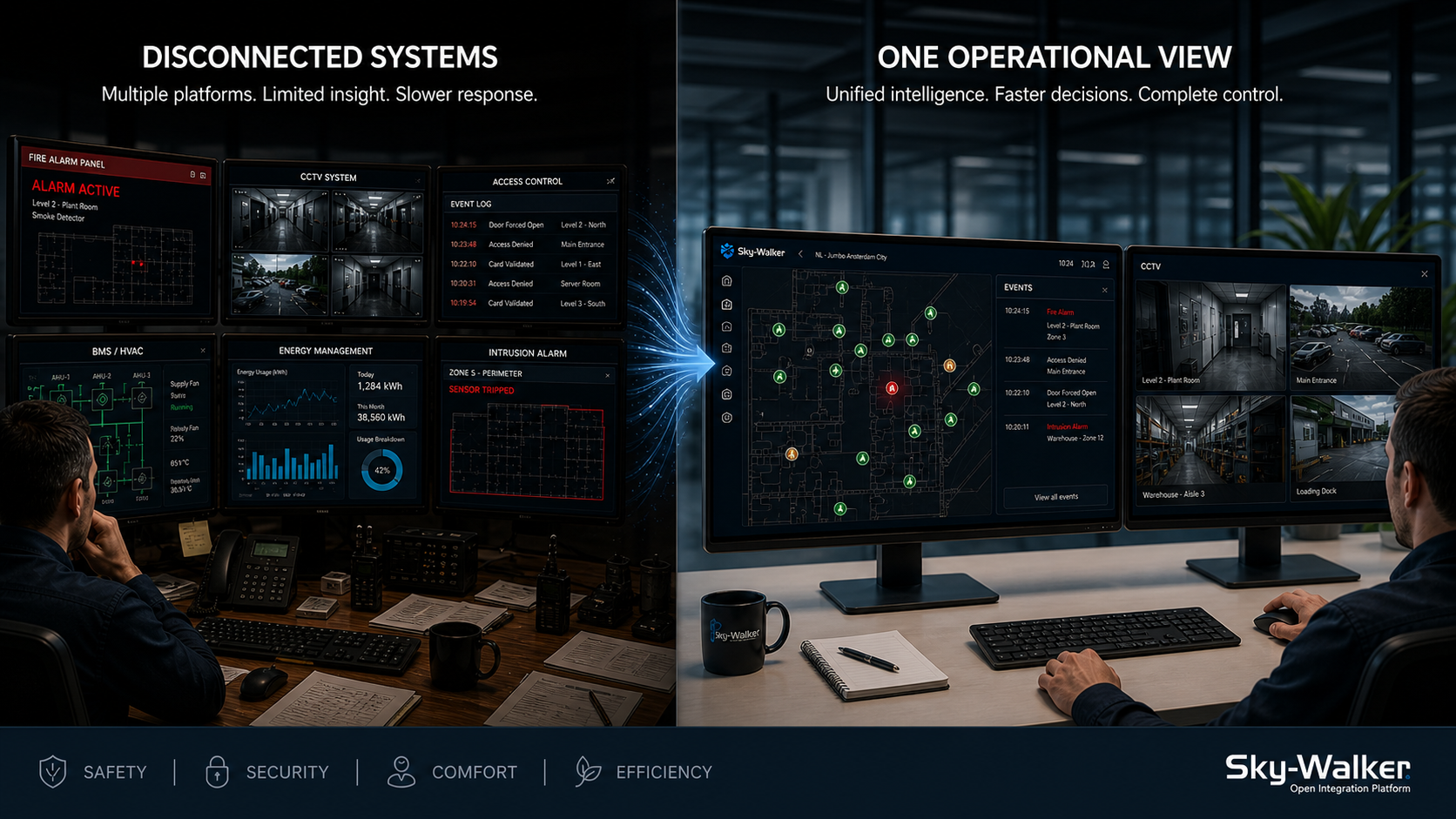
An alarm comes through from a fire panel. It’s not immediately clear if it’s a real event or a fault. The panel itself might be in a remote location. At the same time, there’s no immediate visibility of what’s happening in that area unless someone pulls up the CCTV system separately.
So what happens?
Someone checks the panel.
Someone else checks cameras.
Another person looks at access logs.
All of this is happening in parallel, often with a bit of back-and-forth over radios or phones.
The information is there, but it’s scattered.
And that delay between “something happened” and “we understand what’s happening” is where risk creeps in.
It’s Not About Replacing Systems
One of the biggest misconceptions we see is that solving this problem means ripping everything out and starting again.
In reality, most sites already have the right technology in place. The issue isn’t capability - it’s coordination.
What’s missing is a way to bring everything together into a single operational view.
That’s exactly where Sky-Walker Open Integration Platform comes in.
A Single Interface Changes the Way You Operate
When systems are brought into one environment, the difference is immediate.
You’re no longer jumping between platforms trying to piece together a story. Instead, the system starts doing that work for you.
A fire alarm doesn’t just sit as a line of text, it can automatically bring up nearby cameras, show the exact location on a map, and guide the operator through what needs to happen next.
An access event isn’t just a log entry; it can be tied to live or recorded video so you can instantly verify what’s going on.
HVAC issues don’t sit buried in a BMS; they become visible alongside everything else, so they’re dealt with in the context of the building’s overall operation.
A Few Simple Examples
To make it real, here’s what that looks like day-to-day:
Safety
A fire detector activates → the operator immediately sees the location, nearby cameras, and the appropriate response steps in one place.
Security
A door alarm triggers after hours → the system pulls up the relevant camera and flags it for review instantly, rather than someone having to review another system or go looking.
Comfort & Building Services
A tenant reports an issue → operators can check environmental conditions and make adjustments without leaving the main interface or calling another team.
Nothing revolutionary in isolation - but when it’s all connected, it becomes far more effective.
Less Switching, More Understanding
What we consistently see is that removing the need to switch between systems has a bigger impact than people expect.
Operators become more confident because they’re not second-guessing where to look.
Response times improve because information is already in front of them.
And teams start working together more effectively because they’re all looking at the same operational picture.
It’s a shift from managing systems… to actually managing the building.
Bringing It Back to Control
At the end of the day, buildings haven’t become more complex because of bad technology. They’ve become complex because of how that technology is layered and operated.
Bringing everything into a single, unified interface isn’t about adding more—it’s about simplifying what’s already there.
And once you do that, the way the building runs starts to change quite quickly.
At the end of the day, most buildings already have the systems they need; the opportunity lies in bringing them together in a way that actually supports the people operating them.
When you move from disconnected platforms to a single operational view, the difference is immediate: clearer visibility, faster decisions, and a far more controlled environment. If you’re starting to see those gaps in your own operations, it may be time to look at what a unified approach could deliver.
If you’d like to explore how this could work in your environment, feel free to get in touch or book a demonstration with our team, we’d be pleased to show you what’s possible.